New Mexico Geological Society · Socorro, NM
(575) 835-5410

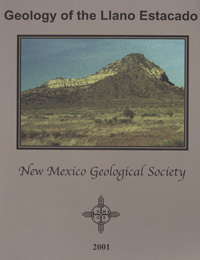
Spencer G. Lucas and Dana Ulmer-Scholle, eds, 2001, 340 pages. https://doi.org/10.56577/FFC-52
Research papers are free to download.
Roadlogs, mini-papers and some other sections are available in print.
The history of geological studies in New Mexico began on 22 September 1853 when Swiss geologist Jules Marcou (1824-1898) climbed a hill about 20 km southwest of what is now Tucumcari. Dubbed by Marcou “Pyramid Mountain,” this hill exposes red beds at its base, overlain by cliffs of yellow sandstone and capped by a thin shale interval from which poured shells of marine bivalves. Marcou identified these bivalves as the oyster-like Gryphaea (they actually pertain to a closely related genus, subsequently named Texigryphaea), and assigned them a Jurassic age. He thus concluded that the High Plains surface here, and throughout the region, is underlain by Jurassic strata. But the bivalves and the rocks that contain them are actually Cretaceous in age, and Marcou’s mistake engendered the first scientific debate about the geology of New Mexico, one that was not resolved during his lifetime. This year, nearly 150 years after Marcou’s visit, the attendees of the 52nd Field Conference of the New Mexico Geological Society will visit Pyramid Mountain. And, although the mountain has not changed much since Marcou, our understanding of the rocks exposed on its flanks has, and is a major focus of the field conference and this guidebook. The first day’s trip takes us across part of the Llano Estacado to examine Permian, Triassic, Jurassic, Cretaceous and Neogene sedimentary rocks exposed at its margins. In so doing we review the entire section exposed around the staked plains, focusing on problems of stratigraphy, sedimentation, biostratigraphy and magnetostratigraphy. The second day begins by examining Mesozoic strata exposed around erosional outliers of the northern edge of the Llano Estacado in Quay County. The second stop will be to Pyramid Mountain. We will also examine excellent expsoures of the Ogallala Formation at Stop 3. On the final day we will explore the geology of the Canadian River drainage from Tucumcari north to Conchas Dam. Here we contrast differences between the beginning and end of the Late Triassic deposition in the vast Chinle Basin, and the continuity of Middle Jurassic eolian deposition across the American Southwest.
Note — Downloads of the papers below are free.
Road logs, mini-papers, and some other sections of recent guidebooks are only available in print.
(includes Dedication, President’s Message, & Conference Organizer’s Message)
Download PDF ↓(658 KB PDF)
(each includes listed mini-papers)
Spencer G. Lucas, Adrian P. Hunt, Barry S. Kues, Andrew B. Heckert, and Virginia T. McLemore, pp. 1-23.
Adrian P. Hunt, pp. 3-4.
Spencer G. Lucas and Gary S. Morgan, pp. 8-9.
Spencer G. Lucas, pp. 12-13.
Vance T. Holliday and Eileen Johnson, pp. 17-18.
Barry S. Kues, pp. 20-21.
Adrian P. Hunt and Spencer G. Lucas, pp. 21-22.
Adrian P. Hunt, Spencer G. Lucas, and Andrew B. Heckert, pp. 22-23.
Spencer G. Lucas, Adrian P. Hunt, Andrew B. Heckert, Barry S. Kues, and Virginia T. McLemore, pp. 25-39.
Virginia T. McLemore, pp. 34-36.
Gary S. Morgan and Spencer G. Lucas, pp. 37-38.
Adrian P. Hunt, pp. 38-39.
Adrian P. Hunt and Spencer G. Lucas, pp. 41-43.
Spencer G. Lucas, Adrian P. Hunt, Andrew B. Heckert, Barry S. Kues, and Virginia T. McLemore, pp. 41-53.
Adrian P. Hunt and Spencer G. Lucas, pp. 44-45.
Adrian P. Hunt, pp. 48-49.
Adrian P. Hunt and Spencer G. Lucas, pp. 51-52.
Virginia T. McLemore, pp. 52-53.
Download PDF ↓(1.80 MB PDF)
Maureen B. Steiner, pp. 59-68.
J. C. Aubele and Crumpler. L. S., pp. 69-76.
R. Douglas Maier, pp. 77-83.
Spencer G. Lucas, Andrew B. Heckert, and Adrian P. Hunt, pp. 85-102.
Jurgen A. Boy, Rainer R. Schoch, and Spencer G. Lucas, pp. 103-109.
Spencer G. Lucas, pp. 111-114.
Andrew B. Heckert, Spencer G. Lucas, Robert Kahle, and Kate Zeigler, pp. 115-122.
Adrian P. Hunt, pp. 123-151.
Patricia C. Hester and Spencer G. Lucas, pp. 153-168.
Andrew B. Heckert, Spencer G. Lucas, Adrian P. Hunt, and Jerald D. Harris, pp. 169-176.
Spencer G. Lucas, Adrian P. Hunt, and Martin G. Lockley, pp. 177-180.
Martin G. Lockley, Joanna L. Wright, Adrian P. Hunt, and Spencer G. Lucas, pp. 181-190.
Spencer G. Lucas, Gary Weadock, Kenneth K. Kietzke, Adrian P. Hunt, and Barry S. Kues, pp. 191-201.
Spencer G. Lucas and Lee A. Woodward, pp. 203-212.
Adrian P. Hunt, pp. 213-214.
Spencer G. Lucas, Barry S. Kues, and Adrian P. Hunt, pp. 215-220.
R. W. Scott, J. M. Holbrook, M. J. Evetts, and F. E. Oboh-Ikuenobe, pp. 221-228.
Barry S. Kues and Spencer G. Lucas, pp. 229-249.
Spencer G. Lucas and Andrew B. Heckert, pp. 251-255.
Adrian P. Hunt and Vincent L. Santucci, pp. 257-264.
Gary S. Morgan, Spencer G. Lucas, Paul L. Sealey, and Adrian P. Hunt, pp. 265-284.
Gary S. Morgan, Spencer G. Lucas, and Mark E. Gordon, pp. 285-292.
Bruce A. Schumacher, pp. 293-295.
Alan R. Dutton, Robert E. Mace, and Robert C. Reedy, pp. 297-307.
Barry J. Hibbs, pp. 309-315.
William J. Stone, pp. 317-319.
Virginia T. McLemore, Lynn A. Brandvold, and Elizabeth A. Carey, pp. 321-332.
V. W. Lueth and T. M. Whitworth, pp. 333-340.
(usually includes a stratigraphic column and/or correlation chart)
Download PDF ↓(611 KB PDF)