New Mexico Geological Society · Socorro, NM
(575) 835-5410

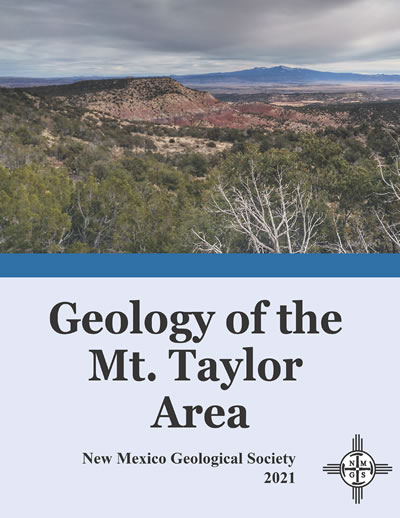
Bonnie A. Frey, Shari A. Kelley, Fraser Goff, Kate E. Zeigler, Virginia T. McLemore and Dana S. Ulmer-Scholle, [editors] 2021, 310 pages. https://doi.org/10.56577/FFC-71
Research papers are free to download.
Roadlogs, mini-papers and some other sections are available in print.
The Mt. Taylor area is a crossroad where geologic history, human history, and societal impacts intersect. Situated on the eastern edge of the Colorado Plateau and flanking the transition zone to the Rio Grande rift, Mt. Taylor is a late Pliocene stratovolcano located on the Jemez Lineament, an enigmatic NE-trending alignment of late Cenozoic volcanic centers. Mt. Taylor lies along the southeast margin of the San Juan Basin bounded by the Zuni (south) and Nacimiento (east) uplifts. Mt. Taylor also has some of the richest uranium deposits in the United States.
The human history of the Mt. Taylor region is no less compelling. Indigenous communities lived here for thousands of years despite Spanish conquest and the establishment of land grants. In the 1800s, the area was settled as part of a U.S. territory, bringing with it commerce such as the railroad and timber industries, and later the uranium boom and its lasting legacy. Additional corridors of commerce opened with Route 66, succeeded by Interstate 40. The designation of Mt. Taylor as a Traditional Cultural Property recognizes the mountain’s importance to Native, Spanish and U.S. cultures.
The papers in this volume cover a spectrum of topics, ranging from geologic studies and mining history to the effects of mining on the population and the environment today.
Edition note
This guidebook supersedes Special Publication 14, which was released in 2020 due to the repeated postponement of this Field Conference until spring of 2022 because of the COVID-19 pandemic.
Research papers are free to download.
Roadlogs, mini-papers, and some other sections are available only in print.
Dedication, President’s Message, and Conference Organizer’s Message
Bonnie Frey, Shari Kelley, Kate Zeigler, and Virginia McLemore, pp. 1-22.
Spencer G. Lucas, Karl Krainer, and William R. Berglof, pp. 23-25.
Virginia T. McLemore, pp. 26-28.
Alva E. Saucier, pp. 29.
Virginia T. McLemore, pp. 31-34.
Virginia T. McLemore, pp. 35-36.
Dan Kapostasy, pp. 37-38.
Diane Nowlin Tafoya, pp. 39-41.
Virginia T. McLemore, pp. 41-43.
Bernadette Tsosie, Craig Goodknight, Allison Kuhlman, and Anthony Farinacci, pp. 44-45.
Gretchen K. Hoffman, pp. 46-47.
Bonnie Frey, Shari Kelley, Fraser Goff, Cathy Goff, Larry Crumpler, and Jayne Aubelle, pp. 49-68.
Bonnie Frey, Shari Kelley, Fraser Goff, and Richard E. Kelley, pp. 69-84.
Virgil W. Lueth, pp. 95-100.
Fraser Goff and Shari A. Kelley, pp. 101-116.
Fraser Goff, William McIntosh, Lisa Peters, John A. Wolff, Shari A. Kelley, Cathy J. Goff, and G. Robert Osburn, pp. 117-128.
Virginia T. McLemore, pp. 129-136.
Victor J. Polyak and Paula P. Provencio, pp. 137-140.
Gary S. Michelfelder, Lawrence K. Horkley, Clayton Reinier, and Sarah Hudson, pp. 141-152.
Robert W. Newcomer, John P. Nybo, and Jakob R. Newcomer, pp. 153-158.
Virginia T. McLemore, pp. 159-170.
Ted Wilton, Chavez, William X., Jr., and Samatha Caldwell, pp. 171-182.
Virginia T. McLemore, Bonnie A. Frey, Ellane El Hayek, Eshani Hettiarachchi, Reid Brown, Olivia Chavez, Shaylene Paul, and Milton Das, pp. 183-194.
Bruce Thomson, pp. 195-202.
Reid Brown and Daniel Cadol, pp. 203-210.
Alexandra R. Pearce, pp. 211-216.
Alicia L. Bonar, Brian A. Hampton, and Greg H. Mack, pp. 217-228.
Spencer G. Lucas, pp. 229-240.
Spencer G. Lucas, pp. 241-250.
Steven M. Cather, pp. 251-258.
Karl Krainer and Spencer G. Lucas, pp. 259-266.
Daniel J. Koning, Matthew Heizler, and Andrew Jochems, pp. 267-280.
Jacob O. Thacker, pp. 281-290.
B. Talon Newton and Shari A. Kelley, pp. 291-302.
Frey, Bonnie A.; Kelley, Shari A.; Zeigler, Kate E.; McLemore, Virginia T.; Goff, Fraser; Ulmer-Scholle, Dana S., 2021, Geology of the Mount Taylor area, New Mexico Geological Society, Guidebook, 71st Annual Field Conference, 310 pp. ISBN: 1-58546-112-1 https://doi.org/10.56577/FFC-71